
Breadcrumbs
Sourcing Culture & Affordability
-
Client: University College Dublin (UCD)
-
Role: Sole UX/UI Designer
-
Tools: Figma
-
Timeline: 2022
Problem
International students in Dublin faced significant "food insecurity" and cultural isolation due to the high cost of groceries and the difficulty of locating specific native ingredients in a foreign market.
The Solution
Breadcrumbs, a centralized mobile platform that combines a real-time price aggregator with a community-driven forum, allowing users to find affordable food and "crowdsource" the location of rare international items.
The Results
A research-backed, high-fidelity prototype that streamlined the search process, validated through testing with 15 users to ensure the navigation solved for the specific mental models of a diverse student body.


Research - Interviews & Surveys
Uncovering the problem
The challenge was to design a digital experience aimed at improving the daily lives of students at University College Dublin (UCD). Recognizing my own perspective as an international student, I wanted to ensure the solution was driven by evidence rather than personal or Western bias.
To remain objective, I began with a series of international interviews to identify the most significant friction points within the student experience. While UCD hosts a diverse, global student body, my initial interviews revealed a recurring and primary pain point:
Food Security and Accessibility.
International students, particularly those from Asian countries, expressed significant difficulty in sourcing affordable ingredients and finding specific items required for traditional home-cooked meals.
International Student Survey
To validate if this was a localized campus issue or a city-wide systemic challenge for Dublin, I distributed a quantitative survey to international students across UCD, Trinity College, and Dublin City University (DCU).
The survey featured eight Likert-scale questions, two multiple-choice questions, and two open-response fields, all focused on the ease of price comparison and the availability of ethnic ingredients.
China, India, and Brazil
were the largest international student populations in Ireland in 2021.
38% reported anxiety
regarding finding affordable food in Dublin, specifically around grocery pricing.
88% struggled
to find specific ingredients necessary for their native cuisines.
74% relied on others
mostly from word-of-mouth recommendations from other students to find reliable shops.
The Official Idea
The data suggested that while price was a factor, the lack of centralized information was the greater hurdle. Students were manually crowdsourcing information from their peers. This led to the concept of Breadcrumbs.
Breadcrumbs
A mobile application that serves two purposes:
1
An automated price-aggregator that scrapes local market data for deals
2
a community-driven forum where users can "ping" the location of rare ingredients, effectively mapping the city's diverse culinary landscape.
Ideation - Information architecture & Personas
Breadcrumbs’ ingredients
Idea Gathering
I audited the necessary feature set to ensure the app met the functional requirements identified in the research phase.
Item Search
-
View by item or store,
-
Price transparency,
-
Product descriptions
-
User reviews.
Store Discovery
-
Map integration,
-
Distance filters,
-
User reviews.
Community Forum
-
Q&A
-
Sharing posts.
Saved Lists
-
Grocery lists
-
Store lists
-
Ingredient lists
Persona
I synthesized the survey data into a primary persona to guide my design decisions and maintain empathy for the end-user throughout the process.

Information Architecture
I mapped the user architecture to prioritize a "search-first" mentality. The goal was to minimize the time-to-value, allowing students to find specific ingredients or price comparisons with as few taps as possible.

Lo-Fi Wire Frames
Low-fidelity wireframes were developed to establish the information hierarchy. I focused on how to display complex data—such as fluctuating prices and store distances—without overwhelming the user interface.

User Testing - Usability Testing & Iterative Design
Taste Testing the Design
I conducted moderated usability testing with 15 international students using the low-fidelity prototype.
Participants were tasked with finding specific items, editing profiles, and navigating the forum.
Critical Iterations:
Search Hierarchy
Testers confused "Item Search" with "Store Search." I moved the item search from an icon to an ever-present search bar right above the bottom nav.
-
Depending on the section, this search bar will hide when the function is not a priority.
Navigation Realignment
I integrated a "Nearby" icon into the navigation so users can quickly see what is around them and search for stores. This helped alleviate the store and item search confusion.
Profile Consolidation
Moved "My Posts" into the profile section, as 13/15 testers went there first when trying to find them.
Store Layout
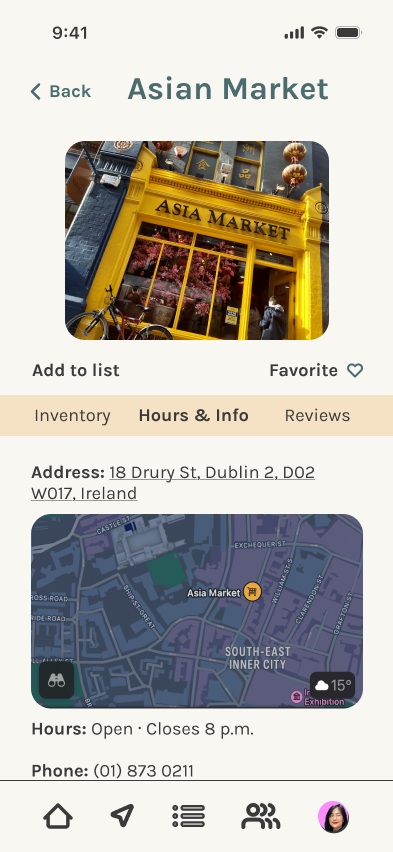
Reorganized the individual store pages to display inventory first, as testers expressed interest in item availability over store descriptions.
HIFI Wireframes - Branding & The Final Baked Product
Adding the Garnish
Branding
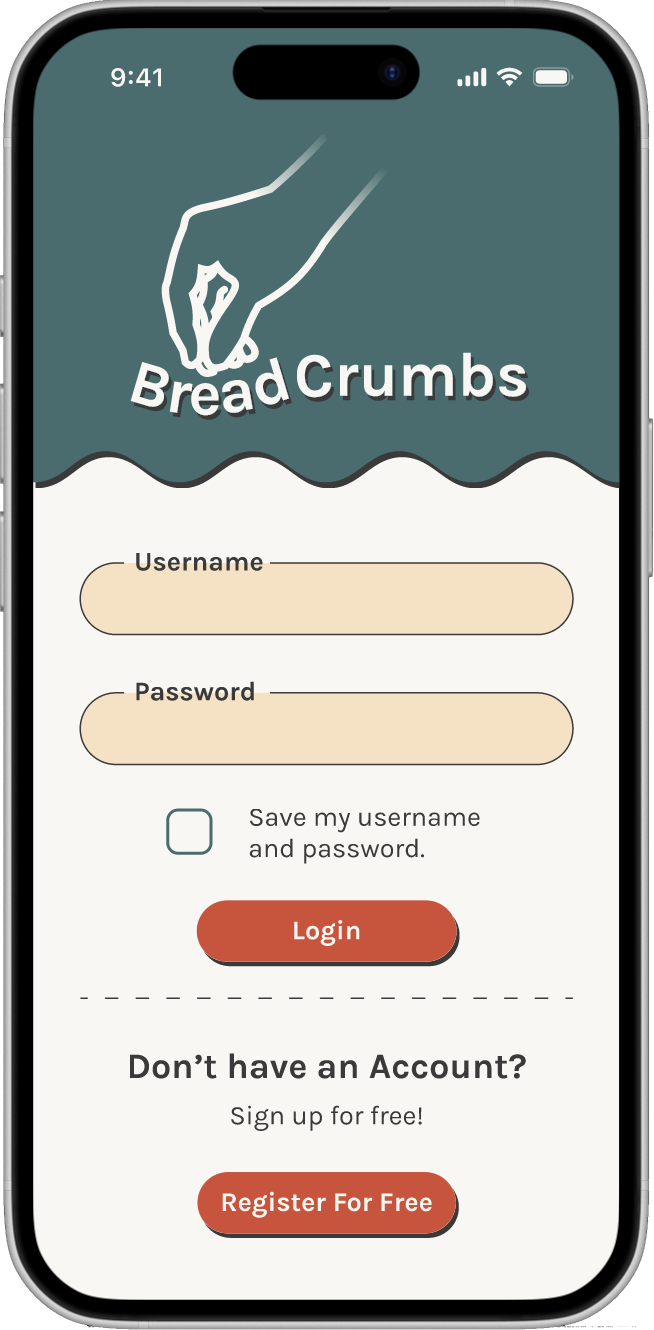
The name "Breadcrumbs" was chosen as a metaphor for the age-old tale of leaving a trail to find one's way home—in this case, using food as the path to cultural connection.
Color Palette
Inspired by universal spices and raw ingredients (turmeric, charcoal, flour). These muted, earthy tones allow the colorful product photography to remain the focal point.
Typography
I selected Karla, a grotesque sans-serif, for its high legibility and friendly, modern aesthetic.
Design System
The UI blends the efficiency of modern e-commerce with the organic, approachable feel of an open-air market.

Hi-Fidelity Prototype
The final high-fidelity designs represent a balance between data-heavy utility and community-driven social interaction.


The Results - Learnings and Future Considerations
Breadcrumbs Finale
The Result
Building Breadcrumbs from the ground up provided invaluable insights into the end-to-end UX process:
Designing for Diversity
I learned to check my Western biases by letting data from marginalized user groups lead the feature set.
Iterative Refinement
The usability testing proved that what seems intuitive to a designer may not be clear to a user in a high-stress or unfamiliar environment.
Systemic Complexity
Understanding the intricacies of system thinking, how one small change in the nav bar ripples through the entire user flow.
Future Considerations
To take this to a production-ready level, I would focus on designing for edge cases, including robust error states and "no results found" screens.
Additionally, I plan to explore motion design to create smoother transitions and loading states that keep the user informed of the app's status during data scraping.
Measuring Success
If Breadcrumbs were launched live, I would evaluate its impact through a mix of quantitative product telemetry and qualitative sentiment tracking across two key pillars:
Daily/Weekly Active Users
Tracking active retention, specifically looking for recurring usage patterns around peak grocery shopping windows (Thursday through Sunday).
Feature Adoption Rate
Monitoring the ratio of users who utilize the automated price-aggregator versus those actively contributing to the community forum
Task Completion Time
Measuring how quickly a user can successfully locate an ethnic ingredient or find a grocery discount compared to our initial manual benchmarks.